 English
 русский
 Deutsch
 日本語
A 180 kg steel door that swings shut on its own almost always has the same story behind it: two struts were picked by eye, fitted, and then "adjusted" until the slamming stopped. The door goes on to eat hinges and crack its frame anchors, and everyone blames the hung leaf. In most cases the struts were simply the wrong force for the geometry.
The short answer
Heavy duty gas struts for doors are specified by calculated force at the hinge — not by door size, and not by copying the strut that came off. Force, geometry, end damping and corrosion class decide whether a door holds open with one finger for 50,000 cycles or fails within a season. The calculation takes ten minutes; the rework takes weeks.
What follows is the working method behind a specification: the physics that sets the force, the numbers that separate a light strut from a heavy duty one, and the two variables that quietly move the force after installation.
Content
How a Heavy Duty Door Strut Produces Force
A gas strut is a sealed cylinder holding pressurised nitrogen plus a small oil charge. The piston rod runs through a guide and seal, and the piston carries an orifice that meters gas and oil as the rod travels. Force comes from pressure acting on the rod's cross-sectional area, which is why a 10 mm rod produces roughly 2.5 times the force of a 6 mm rod at the same internal pressure.
Extension force and compression force are not the same number. The rod occupies volume inside the cylinder, so pushing it in compresses the trapped gas into a smaller space and the force rises — typically 10–20 % on a heavy duty unit with a 10 mm rod. That gap matters when two struts share a door: a ±5 % pair on a 1,200 N door leaves a 120 N imbalance, and the leaf twists every time it opens.
Force rating (N)
Quoted at 20 °C and at a defined rod position. Always confirm whether the figure is extension or compression force; the two differ by 10–20 % on heavy duty units.
Rod and cylinder size
8–12 mm hard-chromed rod and 22–28 mm cylinder for door duty. A larger rod carries higher force and tolerates more side load from a heavy leaf.
End damping
Oil forced through the orifice near the end of the stroke slows the last 20–30 mm of travel, so a 200 kg door arrives at the frame instead of hitting it. A strut with no end damping is cheap for a reason.
Corrosion class
Neutral salt spray hours tell you more than "chrome plated". Around 96 h suits indoor doors; 240–480 h suits exterior and wash-down areas.
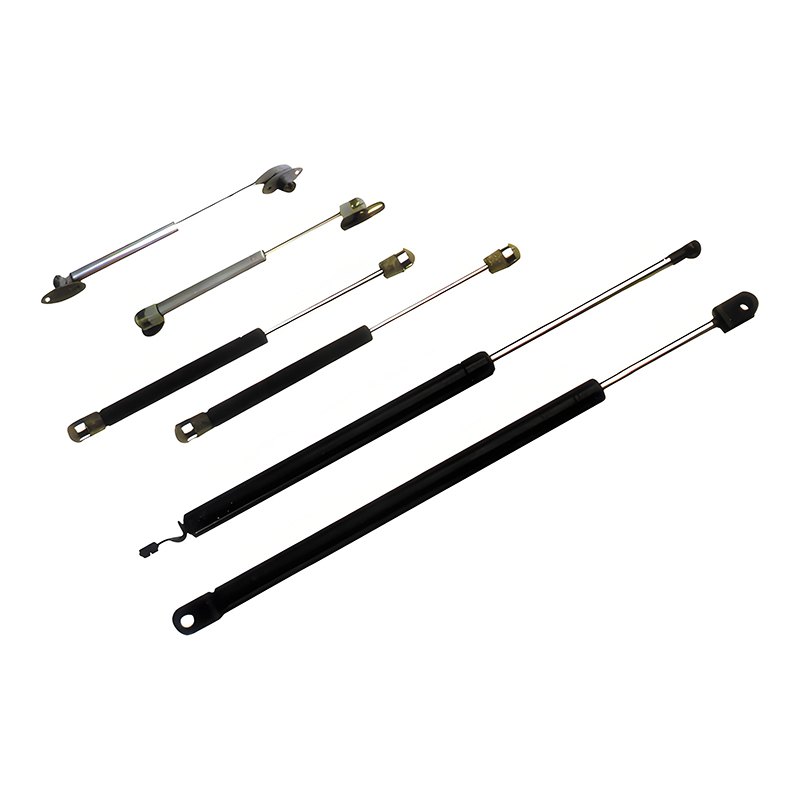 Compact Support Gas Spring for Adjustable PositioningA compact, lightweight support spring that holds any position, useful where door struts need adjustable support in confined installations.View Product →
Comparing Strut Types for Door Duty
Door struts fall into four broad families. What separates them at the door is the force ceiling, the cycle life, and whether the strut is allowed to hold a position part-way through the swing.
Indicative ranges for door applications, measured at 20 °C; exact values depend on stroke, rod diameter and internal pressure.
Two of these deserve a note. Heavy duty fixed-force struts are the default for steel doors, shutters and container doors: nothing to adjust, nothing to release, and a predictable force curve. Lockable struts solve a different problem — the door has to stop at a chosen angle instead of running to full extension, as with plant-room hatches and tilt-up equipment covers. The cost is an operator touchpoint that must be reachable, labelled, and impossible to trip by accident.
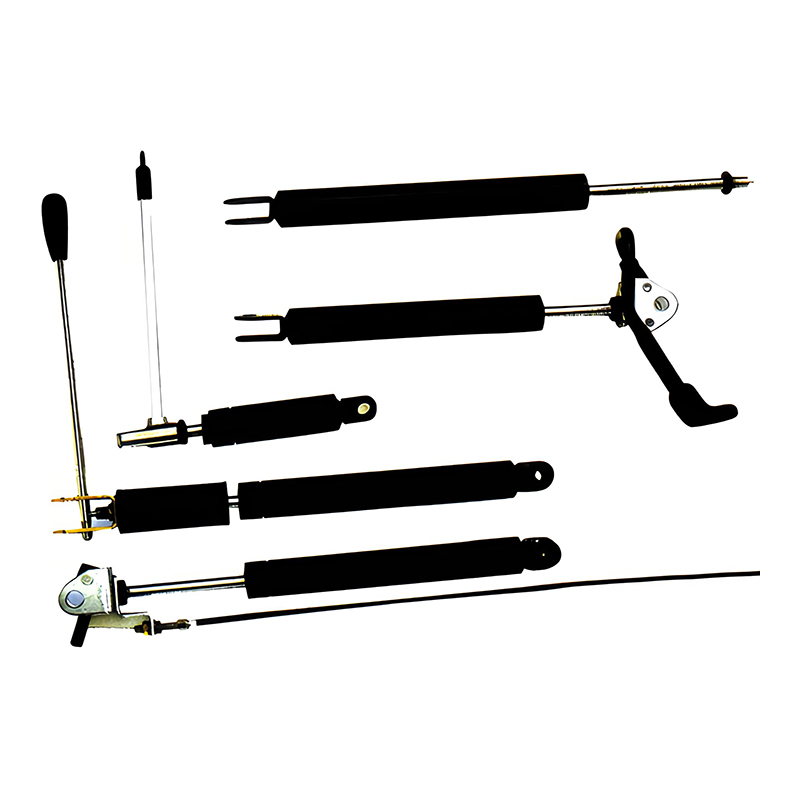 Lockable Gas Spring for Adjustable PositioningAn oil-and-gas lockable strut that stops at chosen positions, suited to applications needing adjustable hold rather than fixed-force operation.View Product →
Two Hidden Variables: Temperature and Cycle Drift
Two factors move the force after the door is hung, and neither appears on most datasheets. The first is temperature: gas pressure tracks absolute temperature closely enough that force follows it. As a rule of thumb, expect a 3–4 % change per 10 °C, so a strut rated 1,000 N at 20 °C delivers around 820 N at -20 °C and around 1,170 N at 60 °C.
82%
-20 °C
91%
0 °C
100%
20 °C
108%
40 °C
117%
60 °C
Retained force as a percentage of the 20 °C rating for a typical nitrogen-filled door strut.
For a door on a factory floor that sees 0 °C in January and 45 °C near a furnace in August, a 1,000 N strut is not one specification — it is a band of roughly 300 N. That band, not the catalogue number, is what the operator actually feels.
The second variable is cycle drift. Force falls as oil migrates and the seal wears: a well-built heavy duty unit loses 3–8 % over its first 20,000 cycles and then stabilises, while a poorly built one loses that much within 5,000 cycles and starts weeping oil past the guide. Ask for a cycle curve, not just a cycle number.
Where Heavy Duty Door Struts Are Installed
Industrial steel doors and fire-rated doors together account for more than half of heavy duty demand, for the same reason in both cases: a heavy leaf on a wide swing is stored energy waiting to be released.
- Industrial and warehouse steel doors — 30 %
- Fire-rated and escape doors — 24 %
- Equipment enclosures and cabinets — 18 %
- Commercial entrances — 16 %
- Transport and special vehicles — 12 %
Fire-rated and escape doors add a compliance constraint. The self-closing function has to stay intact, the strut has to belong to the tested door assembly, and the opening force still has to be manageable for the people using the building. That is why auto-return struts on fire doors are usually specified together with the hardware supplier rather than added afterwards.
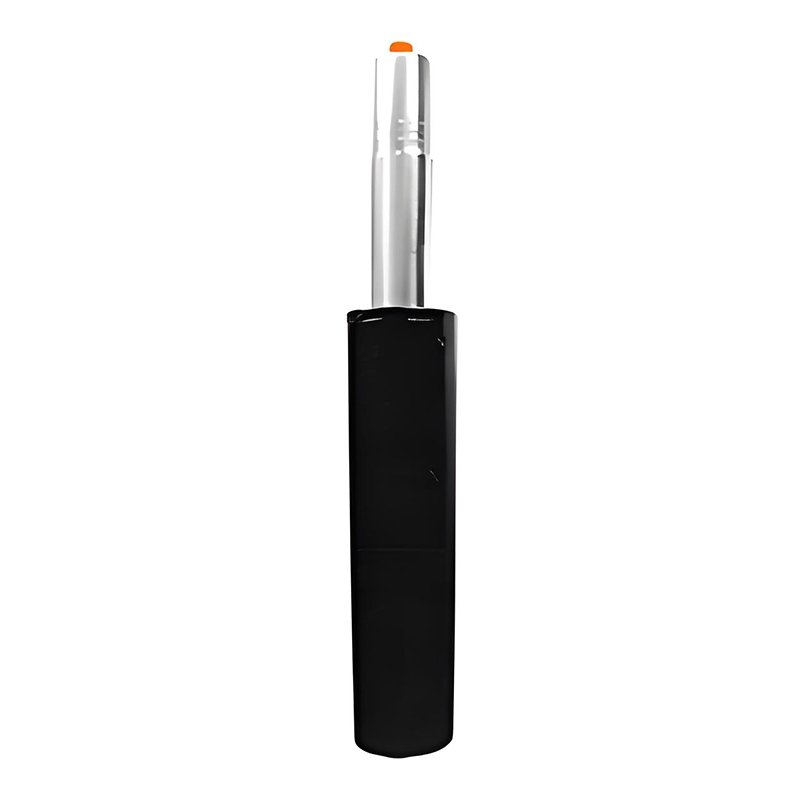 Compact Auto-Return Gas Spring Without Height AdjustmentA compact auto-return spring that resets to a preset position without lifting adjustment, suited to space-limited equipment needing automatic reset.View Product →
Enclosures, machinery covers and cabinet doors follow the same rules at lower force; the notes on gas spring supports in cabinet and machinery applications cover that range in more detail.
A Five-Step Specification Workflow
This sequence assumes a single door with two struts and a horizontal hinge axis, which covers most industrial doors.
1
Weigh the door, find the centre of gravity
Use scales under each edge or the mass from the drawing. The centre of gravity sits near the middle of the leaf, not at the handle.
2
Measure the geometry on the door
Hinge axis to body mount, hinge axis to rod mount, and the swing angle. Measure the real door — a 10 mm error shifts the force by several percent.
3
Calculate the force
F = (W × L) / (n × d): W is door weight in N, L the horizontal hinge-to-gravity distance at the open position, n the number of struts, d the perpendicular hinge-to-axis distance.
4
Fix damping, fittings and finish
End damping above 80 kg, fittings rated for the load, and a salt spray class matched to the site. Specify paired struts to ±5 %.
5
Prototype before the batch
Test at both temperature extremes and through 500 open-close cycles. Check the halfway position, where the strut's mechanical advantage is worst.
The formula is a starting point, not an answer. Strut geometry is non-linear across the swing, and existing mounts rarely sit where the ideal line of action would put them, so the calculated figure should always be confirmed on a prototype.
Maintenance and Compliance Notes
Once the strut is on the door, the maintenance burden is small but not zero.
- Inspect every six months: end fittings for wear, rod for scoring, seal for oil film, and holding force at the open position.
- Clean the rod with a dry cloth. Solvents and abrasives strip the oil film; a thin film of oil is normal and protective.
- Never paint, plate or grind the rod — a damaged chrome surface cuts the seal within weeks.
- Replace struts in matched pairs, otherwise the door loads unevenly and hinges bend.
- Keep the original data — force, stroke, extended length, fitting type — so replacements are a like-for-like swap.
- Fire-rated doors: confirm the strut belongs to the tested hardware set and file the documentation with the door record.
- Scrap as a pressurised item. Never incinerate; depressurise or puncture according to local rules first.
A door weight, a hinge position and a swing angle are enough to start: those three numbers narrow the force band, the stroke and the mounting type before anything is quoted. Send them along with the site environment and expected cycle count through the contact page, and the specification can be pinned down on paper before a single strut is ordered.