 English
 русский
 Deutsch
 日本語
日本語
Content
- 1 Designing Gas Springs: Core Conclusion
- 2 Gas Spring Working Principles: What Determines Performance
- 3 Data Comparison: Common Gas Spring Types
- 4 Hidden Metrics: Temperature and Damping Behavior
- 5 Industry Application Distribution
- 6 Selection Guide and Workflow
- 7 Maintenance and Compliance Recommendations
Designing Gas Springs: Core Conclusion
Let us start with a real scenario. You are designing a machine enclosure with a heavy steel lid. The lid weighs 35 kg, the hinge is at one edge, and you want it to stay open without a mechanical latch. The gas spring needs to provide enough force to counterbalance the lid at every position, but not so much that it slams closed. The difference between a successful design and a field failure is often hidden in the details of force calculation, stroke selection, and mounting geometry.
Core conclusion: Calculate the required force from the load and lever arm, choose a stroke that covers the full travel, then verify the mounting orientation and operating temperature before ordering a prototype.
Gas Spring Working Principles: What Determines Performance
A gas spring is a self-contained cylinder filled with nitrogen gas and a small amount of hydraulic fluid. When the piston rod is pushed in, the gas volume decreases, raising the pressure and creating a restoring force. The hydraulic fluid flows through a metering valve, which controls extension speed and provides damping.
The following four parameters are the most common sources of selection errors:
- Force: The rated force is measured at a specific point in the stroke. It is not constant. As the spring compresses, force rises roughly in proportion to the pressure increase.
- Stroke: This is the distance the rod travels between fully extended and fully compressed positions. A spring that is too long or too short will not allow the mechanism to reach its intended open or closed positions.
- Mounting: The effective leverage depends on the distance between the spring mounting points and the hinge. A spring mounted close to the hinge requires a higher force rating, while one mounted far from the hinge provides more control for the same physical size.
- Damping: For applications where the lid should open slowly or close gently, choose a damped gas spring. Without damping, the spring releases its energy too quickly, which can be dangerous or damaging.
For more detail on the internal mechanism, see our article on how gas spring rods work.
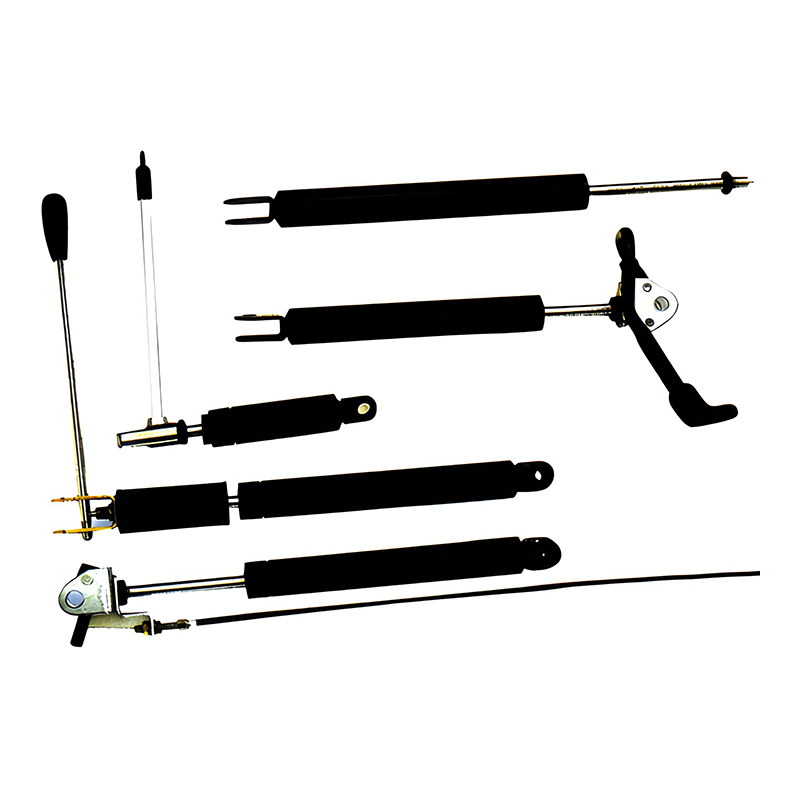 Lockable Gas Spring for Adjustable Seating and FurnitureThis gas spring features an internal oil and gas dual-lock system for precise positioning. It suits office chairs, hairdressing chairs, and hospital beds, offering support from 450N to 1200N with smooth, quiet motion.View Product →
Data Comparison: Common Gas Spring Types
The table below summarizes the practical differences between the four main gas spring configurations used in seating, furniture, and industrial equipment.
Table 1. Comparison of standard, lockable, support, and auto-return gas springs.
Type
Force Range
Locking
Typical Use
Standard
50–5000 N
No
Lids, hoods, flaps
Lockable
100–3000 N
Yes
Chair height, adjustable work surfaces
Support
200–6000 N
No
Static support, cabinets, machinery doors
Auto-return
50–2000 N
No
Retractable seats, return mechanisms
Force ranges are typical for the products we manufacture; custom designs can reach higher or lower values.
Hidden Metrics: Temperature and Damping Behavior
Two metrics that often escape the spec sheet are temperature sensitivity and damping consistency. The gas pressure inside a sealed cylinder follows the ideal gas law. As ambient temperature rises, the force increases; as it falls, the force decreases. For outdoor equipment or machinery near heat sources, this variation can be significant.
The bar chart below shows the relative force of a typical nitrogen gas spring at three ambient temperatures compared to a standard 20°C baseline.
Damping is equally important. If the application requires a smooth, controlled opening speed, the oil viscosity and metering orifice must be matched to the expected operating temperature. At very low temperatures, thicker oil slows the spring; at high temperatures, thinner oil may make it faster.
Industry Application Distribution
Gas springs are used across many industries, but the distribution varies by product type. Based on the applications we serve at ADF, the following pie chart represents a typical split for the gas spring market.
Seating (55%)
Automotive (20%)
Industrial equipment (15%)
Other (10%)
In the seating segment, office chairs and bar stools rely on gas lift cylinders for smooth height adjustment. For a deeper look at seat applications, see the product card below.
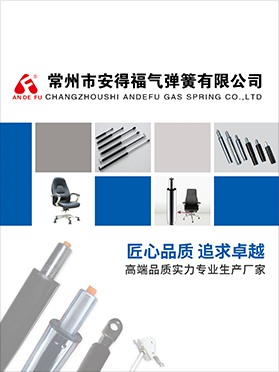 ADF Series Office Chair Gas Lift CylindersThe ADF series provides a range of travel and outer tube lengths, with load capacities of 300-500N. It includes damping for quiet operation and is available in black or electroplated finishes, ideal for office seating.View Product →
Selection Guide and Workflow
Follow these five steps to choose the right gas spring for your design.
1
Define the load
Measure the weight of the moving part and find the center of gravity. For a hinged lid, the required force depends on the distance from the hinge.
2
Calculate force
Use the lever arm equation: F = (W × d) / L, where W is the load, d is the moment arm, and L is the effective spring arm. Add a safety margin of 10–20%.
3
Select stroke
Choose a stroke that allows the mechanism to reach both fully open and fully closed positions. Match the extension length to the available space.
4
Check mounting
Verify the mounting orientation and available pivot points. A gas spring is not designed to be used sideways unless specified.
5
Validate temperature
Confirm the operating temperature range. If the product will be exposed to extreme heat or cold, request a temperature-rated gas spring.
For most applications, our standard product line covers the majority of needs. If a custom force or stroke is required, we can work from your drawing or sample.
Versatile Gas Springs for Chairs and Industrial UsesIncluding bar stool springs and auto-return types, these gas springs deliver smooth height adjustment and buffering. They are durable, low-maintenance, and adaptable to various ergonomic and industrial applications.View Product →Maintenance and Compliance Recommendations
Gas springs are generally maintenance-free, but proper installation and periodic inspection extend service life. Here are the key points to communicate to end users:
- Do not disassemble: Gas springs contain pressurized gas. Never attempt to open or puncture the cylinder.
- Inspect rod and seals: Look for scratches, corrosion, or oil leakage at the rod seal. A leak indicates a failed seal that should be replaced before the spring loses force.
- Mount correctly: Avoid side-loading. The rod should be aligned with the intended motion path; side forces accelerate seal wear.
- Compliance: For seating products, check whether the gas lift cylinder meets applicable standards such as BIFMA X5.1 or EN 1335. For machinery, confirm compliance with the relevant machinery directive.
Regular performance testing is recommended for high-volume production. We can provide sample testing and force certification for your application.
Need a specific design? Contact our engineering team with your drawing or sample requirements.